How 1970s Sequels Began Again Without Erasing the Past
Learn how 1970s sequels such as The Godfather Part II and Rocky II made fresh entry points while keeping earlier choices alive in the story.
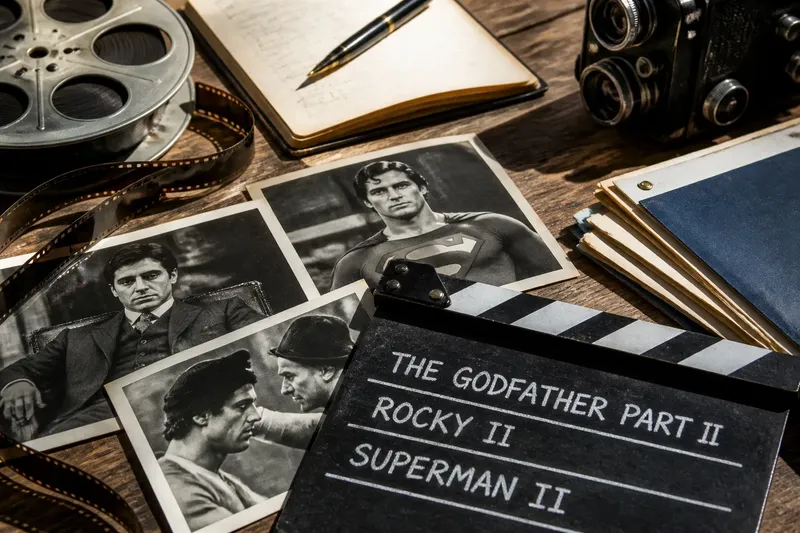
A young Michael Corleone sits at the center of a family business that has already changed hands, while scenes set decades earlier show his father building the power he inherits. In The Godfather Part II (1974), a sequel begins again by moving backward as well as forward. That choice offers a useful way to read how 1970s sequels invited audiences into new stories without pretending earlier films had vanished.
The decade brought several distinct approaches: direct continuation, parallel storytelling, and a shift in the central character’s role. Rather than treating these films as one formula, look at how each turns a sequel’s history into a different kind of dramatic pressure.
The Godfather Part II made the past a second storyline
Francis Ford Coppola’s film does not open with a simple recap of The Godfather. It pairs Michael’s present-day consolidation of power with episodes from Vito Corleone’s youth, making the family’s rise and its later moral costs part of one design.
The structure changes what a sequel can do. A newcomer can follow Michael’s immediate decisions, while the earlier scenes show that the family’s authority was built through choices that echo into his era. The past is not a reference to recognize; it is a parallel story that complicates the present.
Notice how the two timelines differ in mood and circumstance. Vito’s ascent can look like a response to vulnerability, while Michael’s position gives him choices his father did not have in the same way. The contrast invites viewers to consider whether inherited power protects a family or traps it.
Rocky II continued a plot by changing its emotional question
Rocky II (1979) picks up after the championship bout at the center of Rocky. Its new beginning is not a fresh introduction to boxing or Rocky Balboa; it is a continuation that asks what happens after a close defeat has already altered a person’s sense of possibility.
The story turns the next fight into a question of identity and responsibility. Rocky’s choices affect his household as well as his public standing, so the sequel’s familiar boxing goal carries different emotional weight than it did before. The audience sees continuity through changed circumstances rather than a repeated origin story.
This is one way a direct sequel can welcome viewers who remember little of the first film: establish the present problem clearly, then make earlier events matter through their consequences. The film does not need to reproduce every earlier beat for the audience to understand that Rocky is responding to a life already in motion.
Superman II showed how a sequel could split its story across production history
Superman II (1980), released just after the decade, is a useful boundary case for the 1970s cycle. It continued the story begun in Superman (1978), but its production history involved changes in direction and substantial decisions made across the two films.
That background can help explain why a sequel may feel less like a clean new chapter than a story carrying material from an earlier stage of development. For close reading, separate what the finished film presents from what production accounts may explain: the film itself still has to make its character conflicts legible on screen.
Watch how the sequel treats Clark’s private life alongside the threat posed by the Kryptonian villains. The plot gives the returning hero a fresh conflict, but its emotional force depends on what Clark’s established identity and relationships mean in this installment. The film’s new beginning is therefore a change in pressure, not a blank slate.
How can you tell what kind of sequel you are watching?
What makes a sequel a direct continuation?
A direct continuation starts from circumstances created by an earlier film and develops their consequences. Look for ongoing relationships, unresolved conflicts, or a character responding to a prior choice; those elements distinguish continuation from a story that merely reuses names or settings.
Can a sequel begin with a new audience in mind?
Yes. A film can establish its immediate conflict and show why its characters care without explaining every earlier event. The test is whether a new viewer can follow the current choices, even if familiarity with the prior film adds emotional texture.
How does a parallel timeline change a sequel?
A parallel timeline places different periods in conversation, as The Godfather Part II does. The viewer compares the characters’ situations and choices, so the earlier material becomes part of the sequel’s argument rather than a detached recap.
Is a sequel restart the same as a reboot?
Not necessarily. A restart may offer a fresh entry point while preserving characters or continuity; a reboot more openly rebuilds the premise or story world. The distinction depends on whether the film still treats earlier events as part of its characters’ history.
A close reading can separate inheritance from repetition
Choose a moment where a returning character faces a decision, then ask what the earlier film has changed about that choice. In Rocky II, for instance, the next bout is not simply another chance to win: the film connects it to Rocky’s changed circumstances and sense of responsibility. That is inheritance at work, because the sequel gives the familiar goal a new cost.
Imagine a viewer who remembers only that the first Rocky ended with a close fight. They watch the sequel’s domestic scenes, note that Rocky’s public ambition now affects his family, and then see the boxing plot return. The resulting reading is specific: the sequel carries forward the earlier contest, but shifts the question from whether Rocky can go the distance to what pursuing another fight asks of the people around him.
Use these checks while watching. Each one links an observable detail to a reading decision:
- Observe whether the opening states a present conflict; if it does, follow that conflict first, but if it depends on unexplained names or events, note what context the scene withholds.
- Observe whether a past choice changes a character’s available options; if it does, read the sequel as carrying consequences, but if no option changes, treat the reference as background until the film gives it force.
- Observe whether a returning relationship has changed in behavior; if one character now avoids, challenges, or relies on the other, read that change as new dramatic information, but if only a nickname or glance appears, do not infer a full history from it.
- Observe whether a flashback develops its own conflict; if it does, compare that conflict with the present plot, but if it only repeats information already clear, treat it as recap rather than a parallel argument.
- Observe whether the sequel’s central goal has a new personal cost; if it does, track how the old story reshapes the goal, but if the goal and stakes simply repeat, consider whether the film is relying on familiarity.
- Observe whether the ending leaves earlier consequences intact; if it does, read the new beginning as part of an ongoing history, but if it restores the old arrangement, ask whether the apparent restart has erased the prior film’s choices.
It is not worth decoding every repeated object or line as a hidden message. A callback may simply help a series feel familiar, and that is enough unless the film makes it matter to a choice, relationship, or conflict.
The 1970s sequel did not settle on one way to begin again. The Godfather Part II made history a second timeline, Rocky II carried a finished contest into a changed life, and Superman II continued a developing screen world. The useful question is not how much a sequel remembers, but how its particular form of memory changes what its characters can do next.