When Film Details Become Symbols and When They Do Not
Learn to read film symbols by tracing how objects change across a story, so you can build a grounded interpretation without forcing every detail into a clue.
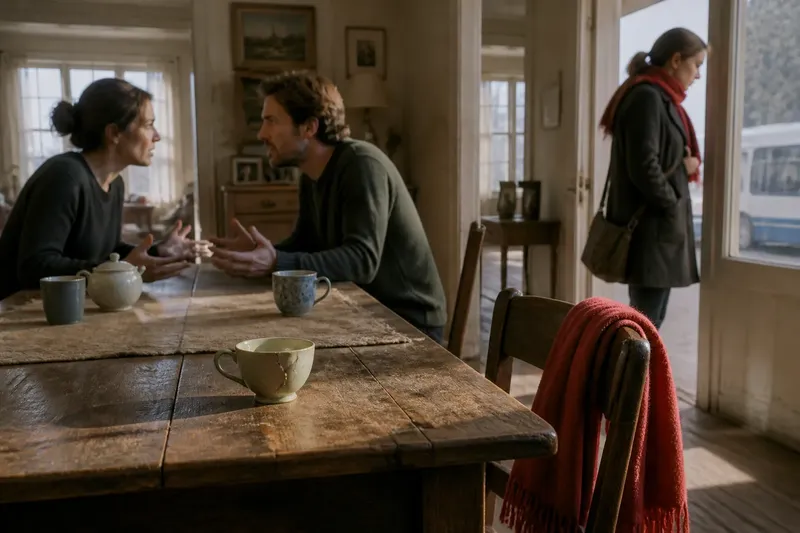
A red scarf rests on a chair while two characters argue; later, one wears it on the bus out of town. To decide whether the scarf works as a film symbol, follow its changing role rather than reaching for a ready-made meaning such as freedom or danger.
A striking detail can attract attention without carrying a hidden message. Props and gestures may shape a scene through practical action, performance, or visual rhythm; sometimes they gather symbolic force as the film develops. The useful question is not simply what an object might represent, but what the film makes it do.
Track the detail’s changing role
Start with concrete actions. Note who handles the object, when it appears, and what changes around it. A house key may first open a door, later become something a character refuses to hand over, and finally remain on a table after the family leaves. That sequence connects the key to access and separation through the story’s actions, not through a dictionary of symbols.
Variation matters more than mere repetition. If the same mug appears in every breakfast scene, the recurrence may establish a routine. If one character begins moving it out of another’s reach after an argument, that change offers a more specific pattern to interpret.
Gestures can develop in the same way, but keep the performer and the character in view. A character might smooth a napkin before answering a difficult question; the motion could suggest an attempt to regain composure, but it may also be ordinary business at the table. Compare it with the actor’s expression, timing, and behavior elsewhere before assigning a motive.
Read a film symbol through its formal choices
Ask how the scene presents the detail. A close-up, a pause before a character touches it, or a cut back to it can give an object emphasis. A prop sitting among many unremarkable items may simply belong to the setting. Framing and editing are evidence of attention, not automatic proof of a fixed meaning.
Listen to the dialogue and watch the performance around the image. If a character jokes about a broken watch while avoiding a direct answer, the mismatch between speech and behavior may matter more than the watch alone. The object’s possible meaning comes from its place in the scene’s choices, not from a universal association.
Genre also affects emphasis. A mystery may invite viewers to inspect a small object as a clue; a comedy may spotlight the same sort of prop for a visual gag. A detail can matter without concealing information, and its effect may be emotional, comic, or practical rather than symbolic.
Keep evidence and interpretation distinct
Write down what happens before describing what you think it means. “Mara turns the photograph facedown when her brother enters” is observable. “She is ashamed of their past” is an interpretation that needs support from the scene and the larger story.
Then compare plausible readings. Does the performance support shame, or could Mara be hiding the photograph for another reason? Do later scenes clarify her action, complicate it, or leave it open? A useful interpretation accounts for several choices—such as framing, dialogue, behavior, and narrative consequences—without inventing motives the film does not provide.
Imagine a fictional drama in which a cracked teacup sits on the table during a family argument. On a later visit to the empty house, a sibling picks up that same cup and turns its crack toward the window. The repeated object and changed handling could support a reading about a damaged family bond; if the cup appears only as background and the visit gives it no particular emphasis, that interpretation would remain a possibility rather than a firm conclusion.
Use the story to revise your reading
Early scenes do not have to settle an image’s meaning. A later appearance might strengthen an interpretation, redirect it, or make the detail less significant. Let new events change your reading instead of treating an initial guess as a promise the film must fulfill.
For a focused viewing note, record the detail, its action, and what the scene does to emphasize it. Then check whether a later appearance changes that role. This keeps attention on a developing visual pattern rather than turning the film into a codebook where every object must stand for one idea.
There is little value in building an elaborate theory around a background prop that never affects the action or draws the film’s attention. If a reading depends on imagined intentions and several unsupported coincidences, set it aside or mark it as uncertain. That restraint leaves room for a stronger pattern to emerge.
Questions about film symbols and visual clues?
Does a film symbol need to appear more than once?
No. A single image can carry emphasis through framing, timing, or its place in the story, but recurrence gives you more to compare. With only one appearance, keep the meaning provisional unless the scene offers other strong evidence.
Can an ordinary prop become a film symbol?
Yes. A familiar object can gather meaning through who uses it, when it returns, and how its role changes. Its practical purpose can remain intact while it also contributes to the story’s emotional or visual pattern.
What should you do when two interpretations fit?
Keep both readings if each accounts for the visible choices without relying on invented backstory. Compare how well each fits later scenes, and allow the film to leave the question unresolved if neither reading takes clear precedence.
How can you tell whether a gesture signals a feeling?
Describe the movement first, then compare it with the actor’s delivery and the surrounding action. A gesture may suggest an emotion, but a single movement rarely establishes a character’s private motive by itself.
Let uncertainty sharpen your reading
Reading film symbols means tracing how an image, object, or gesture participates in the story, not assigning every detail a secret code. Name what the film shows, follow any changes, and treat your interpretation as an argument supported by specific choices.
When a detail remains ambiguous, describe the ambiguity precisely: say what each reading explains and what the film leaves unanswered. That gives another viewer something concrete to discuss, even when the film offers no final answer.